

CutePig Sudoku

Choose difficulty

Sudoku competitions and learning
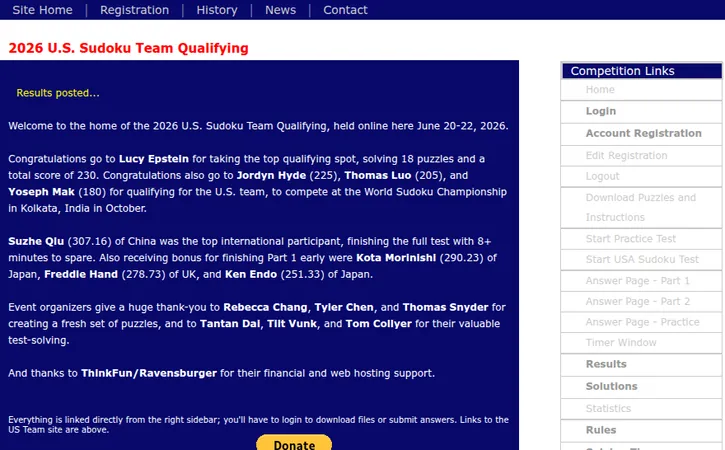
A preview of the U.S. Sudoku qualifier website
Competitions

U.S. Sudoku Team Qualifying

Explore the U.S. qualifier’s rules, results and solution material.

U.S. Puzzle Championship
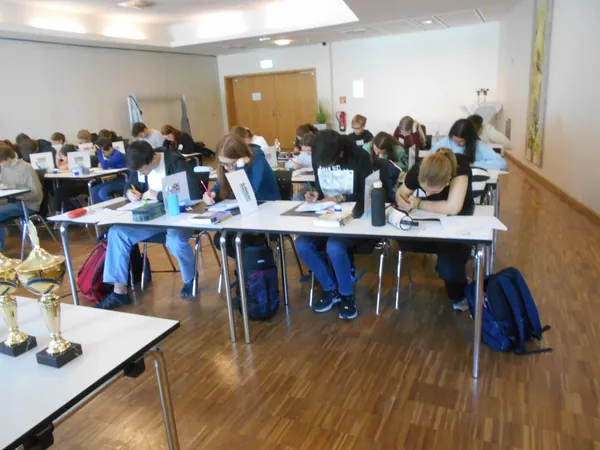
The German Sudoku Championship venue
Competitions

German Sudoku Championship

Explore the German championship, past events and practice material.

Logic Masters Deutschland

The WPF Grand Prix 2026 logo
Competitions

WPF Sudoku Grand Prix

Find rounds, rules and competition material for the World Puzzle Federation’s Sudoku Grand Prix.

World Puzzle Federation

The Chinese National Sudoku Championship venue
Competitions

2026 Chinese National Sudoku Championship

Read the official report about the venue, events and highlights of the national championship.

Social Sports Guidance Centre, General Administration of Sport of China

A grid example from the beginner tutorial
Tutorials

Sudoku rules for beginners

Illustrated rules for rows, columns and boxes, with a first look at elimination.

Sudoku.com
An example of a basic Sudoku technique
Tutorials

Notes and basic solving techniques

Explore examples of candidate notes, singles and pairs, organised by technique.

Sudoku.com
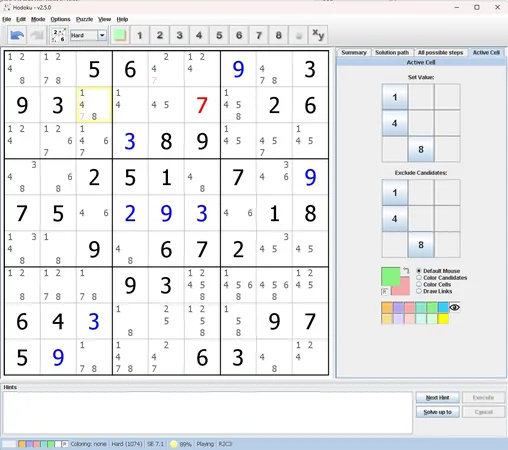
A solving demonstration in HoDoKu
Advanced techniques

HoDoKu: a systematic technique guide

Illustrated explanations of subsets, fish, wings, chains, loops and ALS.

HoDoKu
A SudokuWiki example grid
Advanced techniques

SudokuWiki: families of techniques

Explore how solving methods relate to each other, grouped by structure and difficulty.

SudokuWiki

The Nikoli website graphic
Tutorials

Nikoli: rules and worked examples

Learn classic Sudoku through the publisher’s starting grid, progress and solution examples.

Nikoli
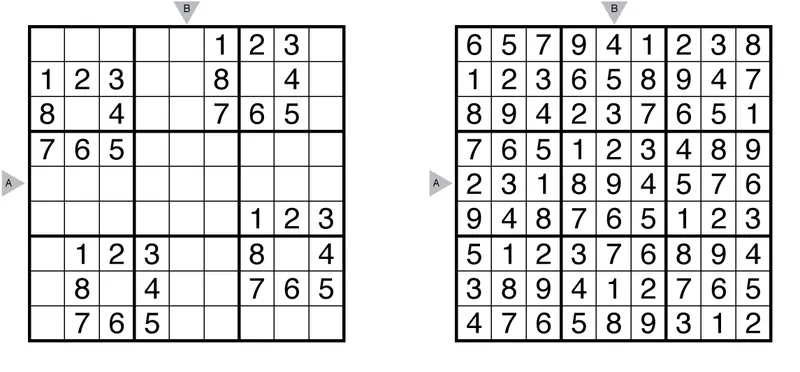
A Sudoku and solution example from GM Puzzles
Variants

GM Puzzles: classic Sudoku and variants

Start with classic rules, then explore irregular, diagonal and other Sudoku variants.

GM Puzzles
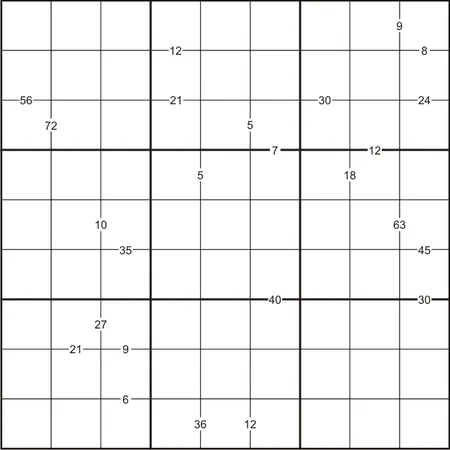
A product Sudoku example from NRICH
Mathematics

NRICH: mathematical Sudoku activities

Cambridge mathematics activities that combine Sudoku with products, multiples and other relationships.

University of Cambridge · NRICH
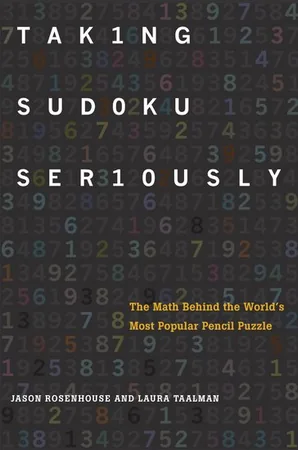
The cover of Taking Sudoku Seriously
Mathematics

Why are at least 17 clues needed?

Discover how mathematicians turned an enormous search into a proof of the minimum-clue result.

Oxford University Press

Difficulty and puzzle scores

Puzzle level—
Difficulty score—
Puzzle score—

What does the difficulty score mean?

The difficulty score maps the total effort for the puzzle onto a 0–10 scale for quick comparison. Higher scores usually mean more observation and reasoning overall. It is not the rating of the hardest step and does not directly determine the technique level.

The puzzle score adds the discovery and solving contributions of every step, with no upper limit of 10. Discovery includes finding techniques and creating notes; solving includes verifying deductions, entering digits, eliminating candidates and maintaining notes.

Difficulty = atan(0.21 × puzzle score) ÷ (π/2) × 10. As puzzle scores rise, difficulty approaches 10. Compare puzzle scores and techniques as well when judging differences between very hard puzzles.

Difficulty levels and techniques

Beginner, Easy, Medium and Hard are classified by the techniques needed. Expert and above allow all implemented techniques and use puzzle score bands: Expert below 30, Extreme from 30 to under 100, and Desperate from 100 upward.

What makes this puzzle difficult?

Site information

IP location data: DB-IP Lite · CC BY 4.0

IP Geolocation by DB-IP

Share Sudoku

Choosing a difficulty

Start with Beginner or Easy if you are new to Sudoku. Try Medium as you learn candidate eliminations, then Hard for subsets, fish and wings. Expert introduces advanced patterns; Extreme features longer chains and branching. Each level includes the techniques of earlier levels.

Puzzle score and difficulty

Puzzle score represents the effort needed to solve a puzzle and can be added for rankings. Each step adds discovery and solving contributions, then all steps are summed. Scores are displayed to two decimal places.

Puzzle score grows with discovery and solving effort. Beginner puzzles are typically around 0.75; Expert is below 30, Extreme is at least 30 and below 100, and Desperate starts at 100.

Discovery: inspect the board, find a technique and build local notes. Solving: verify the reasoning, enter digits, eliminate candidates and update notes.

Import Sudoku

Drop an image here, or paste with Ctrl+V / Cmd+V. PNG, JPEG and WebP are supported, up to 20 MB. You can also paste 81 Sudoku digits, using 0 or . for empty cells.

Clear all entries and notes?

All entered digits and notes will be cleared. The original puzzle and elapsed time are kept. You can undo this action.

Restart this Sudoku?

Your entries and notes will be cleared. The original puzzle and elapsed time are kept. You can undo the restart.

Show the complete solution?

This will solve the Sudoku and overwrite all notes. You can use Undo to return to your current progress.